[email protected] +91 772-2987-077
Chinese check

Chinese check: On the détente in the U.S.-China trade war. 

China has entrenched itself as the world’s foremost factory. 

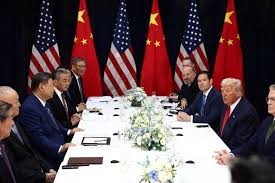
While there may be much relief after the détente in the tariff war between China and the U.S., in Busan, South Korea, following the meeting between U.S. President Donald Trump and his Chinese counterpart Xi Jinping, the uneasy truce has laid bare a structural inversion of power between the two economies. What began in the 1980s as a reluctant embrace of World Bank/IMF-prescribed neoliberal reforms by an overwhelmingly agrarian China, has now evolved into an unimaginable assertion of industrial dominance. A nation that once bartered sovereignty for technology transfer and market access has, through patient accumulation of manufacturing depth, labour arbitrage, and global supply-chain integration, positioned itself as the indispensable node of world production. The irony is sharp. The U.S., whose export and technology corporations once defined global trade cycles, now finds its four-year political rhythms ill-suited to contest a rival that plans in decades. The concessions Mr. Trump has extended to Mr. Xi include some reductions in tariffs, a pause on additions to the “no-trade list” of Chinese firms, and a partial rollback on levies linked to the fentanyl supply-chain dispute. China has promised resumption of purchase of American farm products, particularly soybean, and an easing of export restrictions on critical minerals.

America’s tariff offensives since Mr. Trump’s first term in 2017 did yield some numerical optics. U.S. goods trade deficit with China narrowed by roughly 30%. But economists across the spectrum agree that this was less a triumph of re-industrialisation than a diversion of trade flows. The deficit was largely re-routed through near-shoring and friend-shoring: Mexico, Vietnam and parts of ASEAN became new intermediaries for supply chains once centred in China. Meanwhile, China’s exporters diversified markets and adjusted prices, while the tariffs’ direct burden was borne mostly by U.S. importers and consumers. The human geography of the impact was asymmetric: in the U.S., retaliatory Chinese tariffs targeted farm-belt commodities, hurting those very rural constituencies that powered Mr. Trump’s rise. Federal subsidies softened the blow, but only temporarily. In China, the pain was concentrated in export-processing hubs such as Guangdong and Suzhou, where migrant and urban workers in electronics, semiconductor, and smartphone assembly absorbed the shock. Yet, the political fallout remained contained, cushioned by Beijing’s domestic-stimulus measures and its “dual-circulation” strategy of inward and outward rebalancing. This trade war has thus underscored a decisive shift: the U.S. remains the world’s largest consumer market, but China has entrenched itself as the world’s foremost factory with global leverage over intermediate goods, high-end technology and critical minerals.

-

Check (noun) – restraint, curb, limitation, control, restriction

अवरोध


-
Détente
(noun) – an improvement in the relationship between two or more countries which have been unfriendly towards each other in the past

पहले विरोधी रहे दो या अधिक देशों के बीच संबंध-सुधार

-

Entrench (verb) – Establish, embed, fortify, secure, ingrain

मजबूती से स्थापित करना

-

Foremost (adjective) – Leading, principal, paramount, chief
प्रमुख

-
Following
(preposition) – After

के बाद

-
Counterpart
(noun) – equivalent, opposite number, peer, समकक्ष

-
Uneasy
(adjective) – Anxious, nervous, troubled, uncomfortable, perturbed, edgy

बेचैन, अशांत, चिंतित,

-

Truce (noun) – Ceasefire, armistice, respite, peace, standstill

युद्धविराम

-

Lay bare (phrase) – to reveal or expose something clearly.

उजागर करना

-

Inversion (noun) – reversal, overturning, transposition, flip, shift

उलटफेर

-

Economies (noun) – Countries in terms of GDP

अर्थव्यवस्थाएं

-
Reluctant
(adjective) – unwilling, disinclined, unenthusiastic, grudging, resistant,

अनिच्छुक

-
Embrace
(verb) – Accept, include, encompass, incorporate, contain

अपनाना

-

Overwhelmingly (adverb) – predominantly, mainly, largely, primarily, mostly

अत्यधिक रूप से


-

Agrarian (adjective) – agricultural, farming, rural, countryside, pastoral

कृषि प्रधान

-
Assertion
(noun) – declaration, statement, claim, affirmation, Contention

दावा

-
Dominance
(noun) – Power, control, supremacy, influence, leverage

प्रभुत्व

-

Barter (verb) – trade, exchange, swap, deal, negotiate

वस्तु विनिमय करना

-
Sovereignty
(noun) – Autonomy, Independence, Self-rule, Supremacy, Dominion

  संप्रभुता

-

Accumulation (noun) – Collection, buildup, pileup, aggregation, stockpile 

संचय

-

Labour arbitrage (noun) – exploiting wage differences between countries

. श्रम मध्यस्थता

-
Integration
(noun) – Unification, amalgamation, merging, combining, blending

एकीकरण/ एकता

-

Indispensable (adjective) – Essential, necessary, crucial, vital
अनिवार्य

-
Node (noun) – Hub, junction, focal point, center, nexus
केंद्र बिंदु


-

Irony (noun) – Sarcasm, satirical, contradiction, paradox

विडंबना

-

Sharp (adjective) – acute, keen, intense, severe, strong

तीक्ष्ण

-

Ill-suited (adjective) – inappropriate, unsuitable, unfit, mismatched, incompatible

अनुपयुक्त


-

Contest (verb) – challenge, oppose, dispute, compete with, resist

मुकाबला करना


-
Decade
(noun) – A period of 10 years

दशक

-
Concession (noun) – Allowance, Dispensation, Privilege, Reduction

  रियायत

-

Rollback (noun) – reversal, withdrawal, repeal, rescission, cancellation

वापसी

-
Levy
(noun) – Tax, duty, charge, tariff, imposition

कर

-

Fentanyl (noun) – A powerful synthetic opioid used as a pain medication and anesthetic.

फेंटेनिल

-
Resumption (noun) – restart, restarting, recommencement, reopening, reinstitution

पुनरारंभ

-

Easing (noun) – relaxation, loosening, reduction, alleviation, moderation

ढील


-
Yield
(verb) – produce, bear, generate, return, bring in

उत्पन्न करना/ पैदा करना

-

Optics (noun) – Perception, Appearance, Image, Impression, Presentation

छवि


-
Trade
deficit (noun) – a situation in which the value of goods a country imports is greater than the value of goods it exports

व्यापार घाटा

-
Narrow
(verb) – to reduce the extent or scope of something.

कम होना, घटना

-
Spectrum
(noun) – Range, Gamut, Span, Scope, Array

विस्तार

-
Triumph
(noun) – success, victory, succeed, win, prevail

जीत  

-

Re-industrialisation (noun) – rebuilding a country's industrial base.

पुनः औद्योगिकीकरण

-
Diversion
(noun) – a different route which traffic can take when a road is closed

मोड

-

Near-shoring (noun) – transferring business to a nearby country.

निकट-शोरिंग

-

  1. Friend-shoring (noun) – transferring business to a politically allied country.मित्र-शोरिंग


-
Meanwhile
(adverb) –At the same time इस बीच

-

Asymmetric (adjective) – uneven, unbalanced, disproportionate, unequal, lopsided

असममित


-
Retaliatory
(adjective) – Vengeful, Reprisal, Reciprocal, Requital, Counteractive

प्रतिशोधी

-

Soften (verb) – cushion, mitigate, alleviate, ease, lessen

नरम करना


-
Blow (noun) – setback, upset, shock, disturbance झटका/बाधा

-

Fallout (noun) – consequences, repercussions, aftermath, ripple effects, results

नतीजे

-
Contained (verb) – Limited, controlled, delimited, checked, confined, restricted

सीमित

-

Cushion (verb) – soften, buffer, absorb, protect, shield

सहारा देना


-

Stimulus (noun) – boost, incentive, impetus, push, spur

प्रोत्साहन

-
Underscore
(verb) – emphasize, underline, stress, highlight, accentuate

जोर देना

-
Decisive
(adjective) –deciding, conclusive, determining, final, settling, key

निर्णायक

-

Leverage (noun) – Influence, power, control, sway, clout

  प्रभाव