Sham election: On Myanmar’s three-phase elections.
Myanmar’s junta’s search for legitimacy through controlled polls is futile.
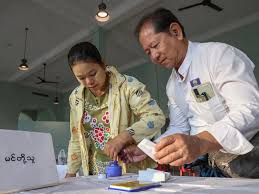
The core of electoral democracy is the institution of popular will through representation. When elections are merely held to subvert this will by imposing favoured candidates, they are clearly a sham. Such is the case with Myanmar’s three-phase elections being conducted by the junta nearly five years after it upended a democratically elected government and precipitated a raging civil war. Sunday marked the first phase in 102 townships, with the subsequent phases on January 11 (100 townships) and January 25 (63 townships). The junta controls barely half the country’s townships, with elections being skipped in at least 65 areas. None of the major parties from the 2020 elections is participating, including the winner, the National League for Democracy (NLD) led by imprisoned leader Daw Aung San Suu Kyi. Only the Union Solidarity and Development Party (USDP), stuffed with former junta figures, is a force. This reminds one of the 2010 elections under the 2008 constitution which the NLD boycotted and which the USDP swept. But the situation is worse now, with the junta bombing and killing thousands of citizens for five years. It also faced its strongest challenge since the early 1960s as ethnic armed organisations and the NLD-affiliated People’s Defence Forces (PDF), loyal to the opposition National Unity Government formed by NLD exiles, won control of significant territory. By late-2023, this coalition, armed with Chinese weapons, dealt the biggest blow through the Three Brotherhood Alliance (TBA) in Shan State and Rakhine, seizing townships along the China border.
The junta, sustained by Russian and Belarusian weaponry, was on the back foot until China changed tack in 2025, prioritising its geo-economic interests, particularly access to the Indian Ocean. Beijing pressured the TBA to cease hostilities and return control to the junta, which two groups reluctantly did earlier this year. This shift, as well as the lack of centralised command among Bamar-dominated PDFs and other ethnic insurgent groups, have allowed the junta to regain lost territory. Yet, the junta faces pitched battles across Rakhine, Karenni, Karen, Chin States and the Sagaing Region where it has only nominal control. Only China, Russia and Belarus have endorsed these “elections”, and reports from Myanmar’s capital and junta-controlled areas suggest participation to be far lower than in 2020. For now, the junta seeks legitimacy as it has gained a semblance of control or managed a bloody stalemate in the civil war. The military, led by tinpot leader Min Aung Hlaing, will retain its constitutionally enshrined 25% non-elected quota of legislative seats, ensuring army dominance regardless of results. But if history is a guide, farcical elections will not win popular support and Myanmar must brace for more conflict.