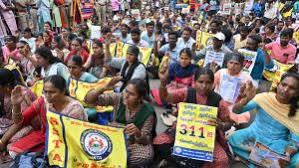
Right to dignity : On ASHA and anganwadi workers’ protests.
Governments must ensure equitable pay for ASHA workers.
The ongoing protests by ASHA and anganwadi workers in West Bengal demanding their wages be increased to ₹15,000 a month is a sour reminder of efforts to deny them permanent employee status despite their centrality to many national and State welfare schemes. The Indira Gandhi government denied the first of many of these workers ‘worker’ status under the Integrated Child Development Scheme (ICDS), laying a foundation that India has continued to build on to bypass labour laws. As the workload increased, the formation of a national union followed in 1989, but even in the liberalisation era, the state created the category of ‘scheme workers’ and expanded social schemes but not permanent government jobs. The State of Karnataka vs Ameerbi (1996) — tribunal decision — further excluded anganwadi workers from the set of government employees even as the top court expanded the right to food, and thus the need for these workers, in 2004. The ASHA programme took root in the mid-2000s and followed a similar trajectory, with the government framing them as ‘activists’. Worse, in the 2010s, when the government, employers, and workers’ unions recommended job regularisation, minimum wages, and pension and gratuity for ASHA workers at the 45th Labour Conference, successive UPA and NDA governments chose not to implement this. In 2015, the NDA government slashed the ICDS budget, and these workers have been protesting since at regular intervals just to make ends meet.
The Centre also froze its contribution to these workers’ pay in 2018, in effect leaving ASHA and anganwadi personnel to absorb fiscal shocks. Together with the lack of a guarantee of better working conditions for gig workers in the new labour codes, the state has effectively exited the social contract for many of its most vulnerable labourers in favour of promoting business metrics and more fiscal headroom at the Centre. States do wield more power in hiring and dispute resolution and are also more vulnerable to electoral pressure, which unions have taken advantage of, but there is also considerable disparity between States. As central honoraria stagnated, States were compelled to top up payments from their own budgets. Predictably, wealthier States and those facing sustained Union pressure have been able to offer more or additional benefits than fiscally constrained ones. Nonetheless, it is unconscionable that the practice of denying these workers their due still continues to be knowingly exploitative. The Centre must legally reclassify these ‘volunteers’ as statutory employees under the Code on Social Security, guaranteeing minimum wages and pension coverage. The Centre and States must also bridge fiscal gaps to ensure equitable pay across regions. Only by institutionalising these protections can India grant these essential workers their rightful dignity.