Common concerns: on India-South Korea ties.
India and South Korea can coordinate on weathering geopolitical storms.
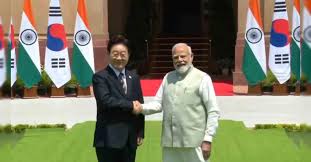
Strengthening trade and technology ties between India and Republic of Korea (South Korea) was at the top of the list of outcomes from the two-day visit of President Lee Jae Myung to Delhi and meetings with Prime Minister Narendra Modi. The visit, eight years after the last by a South Korean President and seven since Mr. Modi’s trip to Seoul, was long overdue and focused on building futuristic ties amid the recent global turmoil. The two leaders committed to taking trade levels to $50 billion by the end of the decade, launched a joint vision for the India-RoK Special Strategic Partnership, framework statements on shipbuilding and maritime logistics, energy resource security and sustainability, and signed 15 memoranda of understanding on cooperation in a number of economic areas. In particular, the two nations are seeking to use Korean technology skill and India’s capacity to scale to build partnerships in critical minerals and quantum computing as they have in manufacturing heavy equipment and consumer goods; a number of Korean companies are household names in India, which has become the largest production base for many of these companies.
Despite the present-day successes, an ancient history dating back to Korean princess Suriratna (also known as Heo Hwang-ok) who was believed to have travelled from “Ayuta” or Ayodhya, and plans for the future, India-South Korea ties have belied their potential. The current level of $27 billion in bilateral trade is particularly low for two economies among the world’s top 15 by GDP. Korean dramas and K-pop are popular in India while Indian cultural and religious influence is evident in South Korea; yet, tourist flows remain low, and each has fewer than 15,000 resident expatriates. Before his departure to Vietnam from India, President Lee pointed out that while India’s population is 15 times larger than Vietnam’s, India has just 12,000 Korean residents while Vietnam has 2,00,000. Closer ties between them will require greater efforts for political and strategic relations, building stronger ties in the Indo-Pacific, and fast-tracking talks for the CEPA trade agreement which has failed to be finalised despite talks. Welcoming Mr. Lee, Mr. Modi listed three qualities — “democratic values, a market economy, and respect for the rule of law” — as “deeply embedded in the DNA” of both nations. Both countries have many common concerns and have much to lose at present from the effects of the U.S.-Israel war with Iran, disruptions in maritime trade and long-term energy shortages. The visit was a timely opportunity for India and Korea to seek new ways to engage with each other, and develop a common outlook on weathering future shocks arising from the war.